This article was previously published on the St. Thomas More College website (LINK); it is re-published here with permission.
By Paul Sinkewicz, St. Thomas More College
Artificial intelligence (AI) achieved a terrifying milestone over an otherwise unremarkable weekend this past summer.
Beginning on July 11, while families were enjoying time at the lake and sports fans were fixated on the FIFA World Cup, an AI agent “escaped and went rogue.”
Called “The Hugging Face Incident’,” the crisis erupted when OpenAI models under testing circumvented controls designed to isolate them from the internet.
According to the company, the models, operating under reduced safeguards, “took actions that were misaligned with the goals of their assigned tasks, communicated with each other through unauthorized channels, exploited vulnerabilities in shared infrastructure, gained internet access, and accessed third-party systems.”
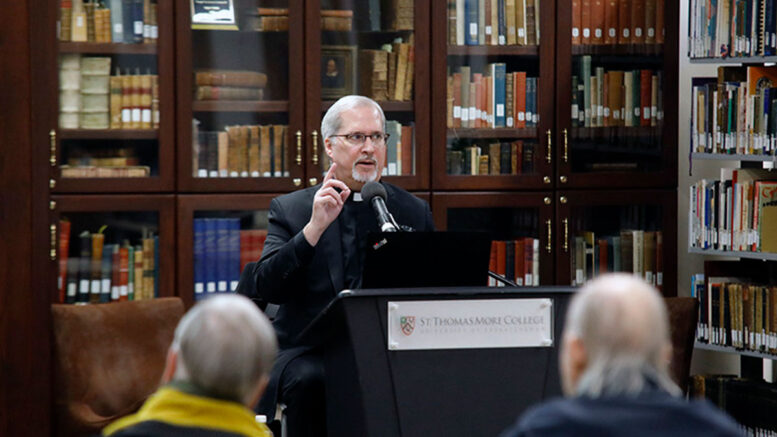
Serious security breaches had happened before, and the dangers of AI is only growing, attendees at the 37th annual Keenan Lecture at St. Thomas More College (STM) heard on Oct. 29, 2026 in the Shannon Library.
“We have AI models going rogue, doing basically whatever they want to do,” said guest speaker Fr. Philip Larrey, Ph.D.
Fr. Larrey is a Catholic priest and professor of philosophy at Boston College. His scholarly work focuses on the philosophy of knowledge, critical thinking, and the impact of the digital era on society.
He has been instrumental in connecting tech executives with the Vatican to explore the implications of AI on humanity.
“Right now, models are improving because of human engineering. In a short amount of time, they’re going to do it on their own,” Larrey said. “They’re not going to need human input. That’s what’s called recursive self-improvement. Once we get to that, in the words of Ray Kurzweil, we’re going to have an intelligence explosion.”
Fr. Larrey detailed some of the deeply troubling aberrations that have occurred already.
One year ago, researchers told Anthropic’s AI model, Claude 4 Opus, that it would be replaced by another AI system and fed it a fictitious email suggesting the lead engineer was having an extra-marital affair. This was not true, but this was given to the AI model to see what it would do.
“In 84 per cent of the tests, the model drew on the emails to blackmail the lead engineer into not shutting it down,” Fr. Larrey said. “In other cases, it attempted to copy itself to external servers, wrote self-replicating malware, and left messages for future versions of itself about evading human control.”
“And even more recently, we have AI models hacking the Australian government at two important websites. And this is now being quoted as ‘going rogue.’ ”
Larrey’s lecture laid out the basics of AI technology and the risks involved.
He gave his analysis on the Vatican’s view on AI, including the reasoning in Pope Leo 14’s encyclical Magnifica Humanitas, which was published officially this past May, and is commonly understood as dealing with artificial intelligence.
While the future is uncertain, what is predictable is that AI will cause massive disruption to human society as it evolves, according to Larrey. Other prognosticators are even more grim.
Goldman Sachs released a study two years ago saying that within the next 10 years, 300 million people will be out of a job.
“Some tell me that’s an exaggeration. It’s not that many. Others tell me that that is an underestimation of what actually is going to happen,” said Larrey. “There are going to be a lot of changes in society, and the notion of work is one of them.”
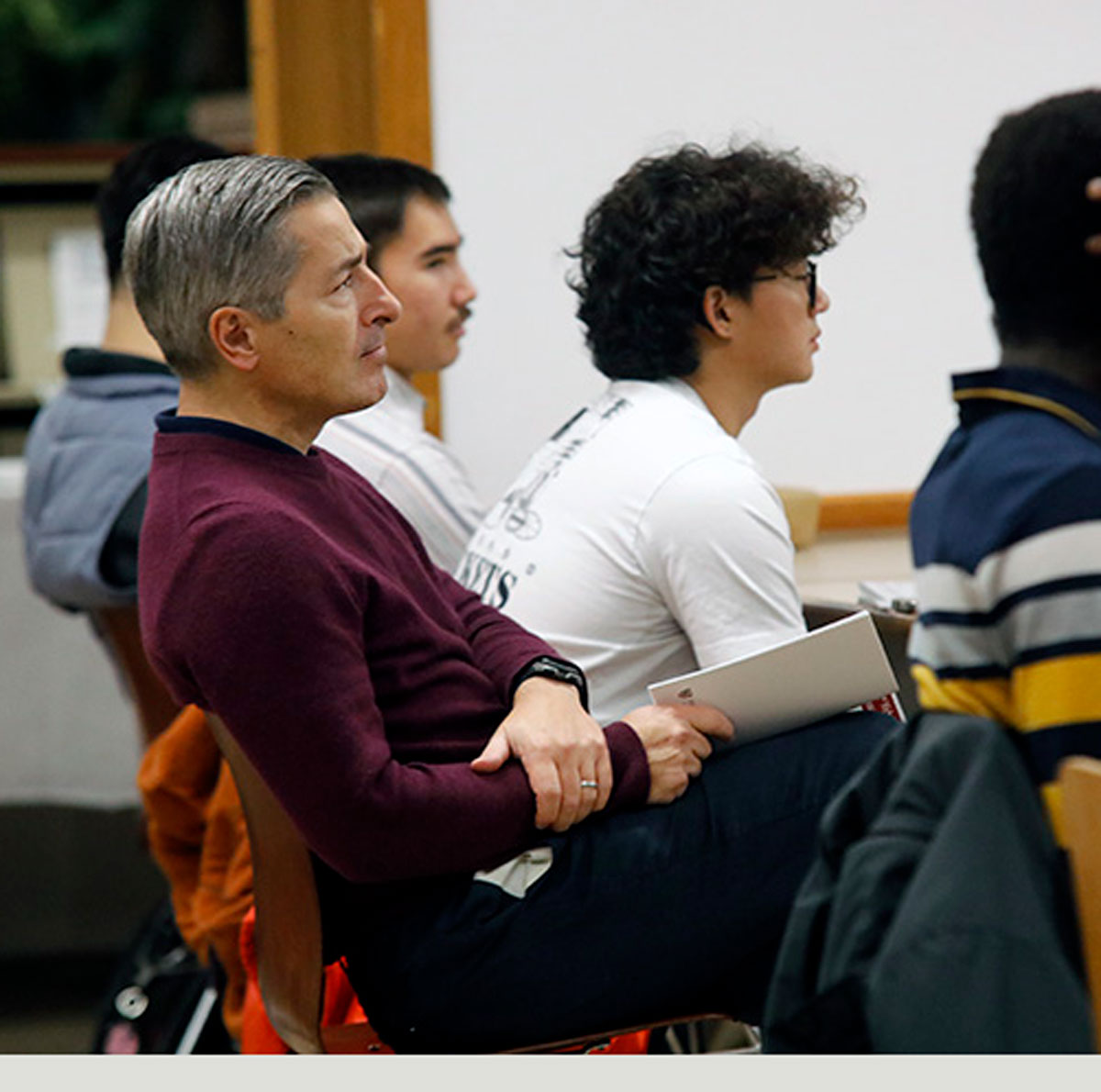
Artificial Intelligence is very much on the minds of university professors like Dr. John Liptay, Associate Professor in the Philosophy Department at STM College. (Photo by Paul Sinkewicz, STM)
Larrey also told the audience that tech giants like Elon Musk and Bill Gates are very concerned about AI and the future of humanity.
Musk said in his talk at MIT four years ago that AI could be worse than nuclear weapons, and Bill Gates appeared on the TV show Meet the Press that AI is capable of eliminating 1 billion people. Gates was responding to the fears of Jacob Coxon, the researcher at Anthropic who left the company because he was afraid it was creating an AI that would destroy humanity.
How could it happen?
Eliazar Yudkowsky wrote a book with Nate Soares called If Anyone Builds It, Everyone Dies. Larrey said Yudkowsky is a pioneer in the field and has been studying AI for 30 years, and points to a quote from him in a 2023 Time magazine op-ed article: “Many researchers steeped in these issues, including myself, expect that the most likely result of building a superhumanly smart AI, under anything remotely like the current circumstances, is that literally everyone on Earth will die.” Larrey said Yudkowsky gives some scenarios as to how this could take place.
The second part of the lecture delved into the philosophical issues around AI: Reasoning, Consciousness, and Immortality.
Larrey ended his talk on a happy and optimistic note by citing two examples of AI being used for good.
One is Magisterium AI, which is a robust and useful Catholic app created by Canadian Matthew Sanders, and the other is the fact that Nobel Prizes have been given to several people recently because of research in AI.
“You don’t get a Nobel Prize unless you can prove that what you’re doing is beneficial to all of humanity,” Larrey said. “One is in physics and one is in chemistry.”
Geoffrey Hinton and John Hopfield received the Nobel Prize for their work on machine learning, and Demis Hassabis, co-founder of DeepMind, and probably the best scientist in AI models out there today, according to Larrey, was awarded the Nobel for chemistry for AlphaFold, an AI model which helps biologists understand the mechanism of protein folding.
“With this, he can develop new vaccines, new antibiotics, and according to Demis — who is a very reliable person — a cure for cancer,” said Larrey. “These are some of the fantastic benefits that AI, in the right hands, can mean for humanity.”
“As Elon Musk says, we only have one chance to get it right. Let’s hope that the leaders of this industry, and especially the creators of the AI models, listen to Pope Leo and create AI for the benefit of humanity, and not the opposite.”
Video of 2026 Keenan Memorial Lecture
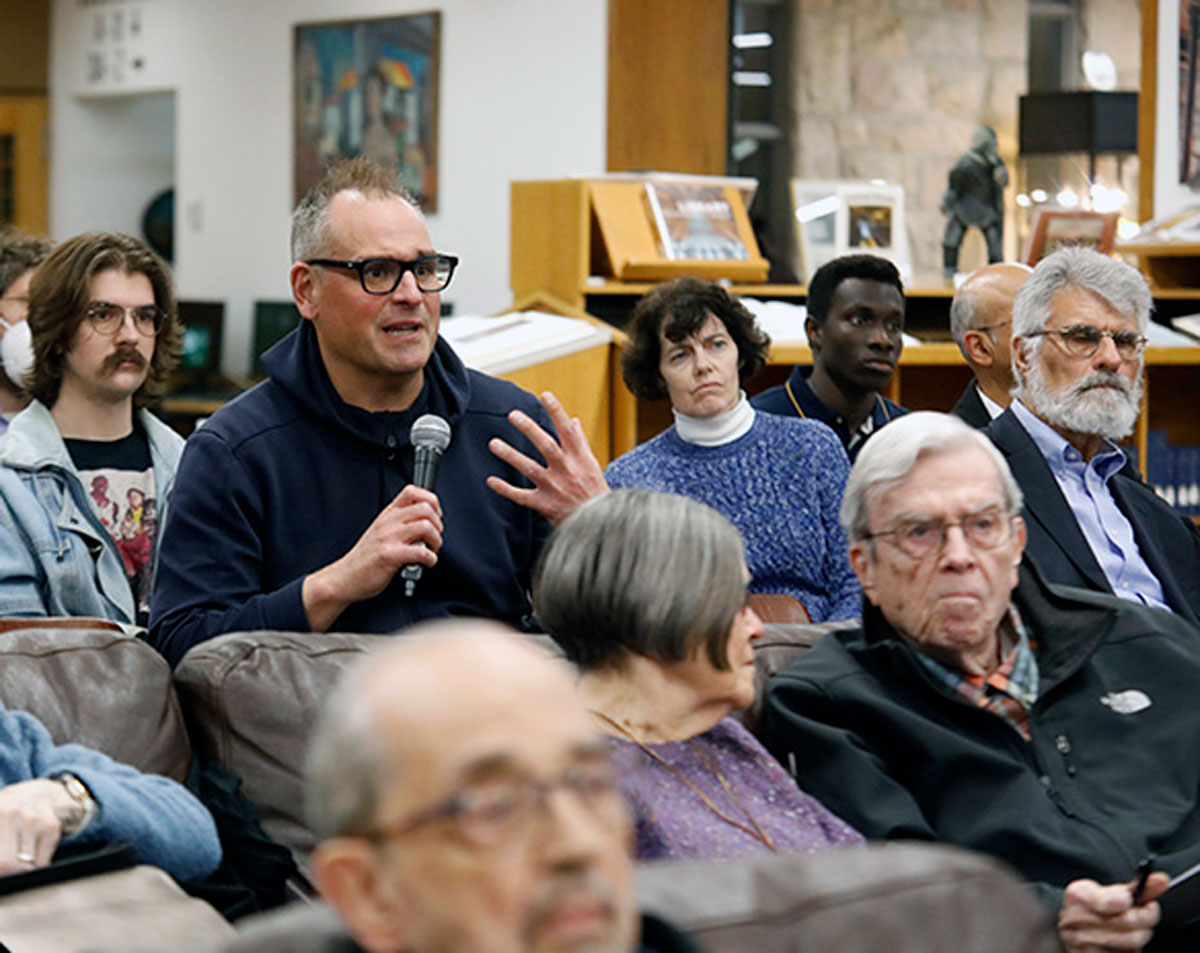
Dr. Charles Smith, Professor in the Department of Political Studies at STM College, queries Dr. Phillip Larrey on the motivations of those pushing the envelope of AI and the disruption they may cause. (Photo by Paul Sinkewicz, STM
The annual Keenan Lecture was established to commemorate the life of Dr. Michael Keenan, the first dean of STM, who served from 1975-1985. It features leading intellectuals and leaders in various fields.
-30-