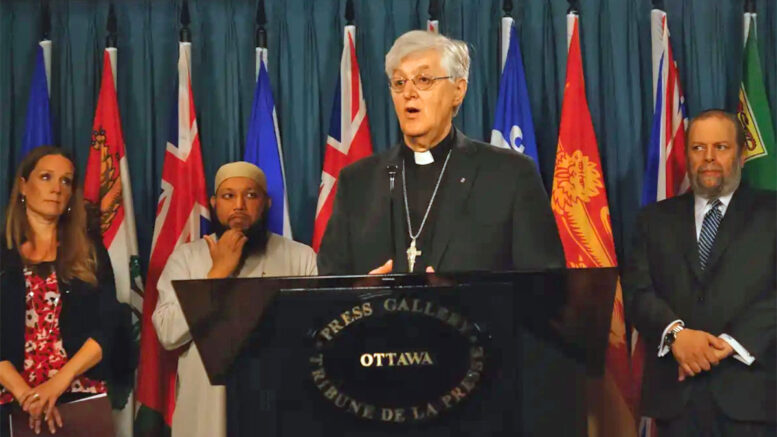
Parliamentary committee study underway for Bill C-41, which says no to MAiD for mental illness and yes to advance directives
By Quinton Amundson, The Catholic Register
[Canadian Catholic News] – After passing the House of Commons at second reading on Nov. 17, 2026, Bill C-41, the MAiD Safeguards Act, will be studied by the Standing Committee for Justice and Human Rights for the first time on Nov. 19.
The key 225-89 vote was notable for the split among Conservative MPs. Thirty-seven Conservative MPs broke party ranks and joined the Liberals, Bloc Québécois, NDP and the Green Party’s Elizabeth May to advance this legislation, while the 89 other members chose ‘nay.’
Bill C-41 calls for decriminalizing advance directives for euthanasia and assisted suicide and maintaining the exclusion of mental illness as a sole criterion for accessing medically-provided death (known as “MAiD”). The exclusion for mental illness becomes null and void on March 17, 2027, unless legislation of some form is passed to continue the prohibition.
Related: Canadian Catholic bishops urge parliament to split bill, call for advocacy – Article
Catholic MP Garnett Genuis was among the dissenting voices. He spoke to The Catholic Register before the final hours of debate devoted to Bill C-41 on Nov. 16. He rendered criticism of the Liberal government’s move to not advance a separate piece of legislation concerning the mental health exclusion and allow more time to scrutinize advance directives considering the potential dangers.
“They would create the conditions in which a person could be killed without even being asked how they feel about it in the moment,” said Genuis. “(They’ll) create the conditions in which a person could get a diagnosis, which they don’t understand well or haven’t experienced yet. They become concerned about the implications of that, so they sign an advance request, but then their lived experience of that disease is different than they expected, and they want to continue to live, but then somebody ends their life without even asking them.”
While Bloc MP Rhéal Éloi Fortin joined his party members in offering unanimous support for Bill C-41, he questioned Minister of Justice and Attorney General Sean Fraser how he could “justify the fact that he is now disregarding the rules of democracy, cutting short debate and fast-tracking a bill that he said himself was very important?”
Fraser expressed disagreement with Fortin and others who expressed concern that the measures in the bill – especially advance directives – have not been thoroughly studied.
“Parliament has conducted a few studies on these issues, we have debated them in the House and the Senate, and the government has produced many reports,” said Fraser. “Now it is time to implement the changes, which are informed by the expertise of medical professionals, and which reflect the need to address this disease for those who suffer from it.”
Fraser also maintained that the bill includes strengthened guardrails that allow a revocation of consent. He alluded to the passage that states, “a practitioner cannot administer a MAID substance based on an advance request if the patient ‘demonstrates, by words, sounds or gestures, refusal or resistance to have the substance administered to them’.” If there is ambiguity, a provider is mandated to wait 30 days before making another attempt. Per the bill, involuntary words, sounds, and gestures are not considered a demonstration of noncompliance.
The Canadian Conference of Catholic Bishops (CCCB) recent 18-page brief on the legislation warned that the “interpretive responsibility also falls on families, care teams, and institutions. Disagreements may arise regarding what the person intended, whether the specified conditions have arisen, or how to understand current responses. Making end-of-life treatment decisions for others can impose significant and lasting emotional burdens, which could be exacerbated by interpretive uncertainty or disagreement.”
Archbishop Emeritus of Valleyfield, Quebec Noel Simard told the Register that the CCCB hopes to be called as a committee witness for Bill C-41.
Find the CCCB brief and resources at: cccb.ca
-30-
Canadian Catholic News (CCN) is a national news service, with members including Catholic newspapers, organizations, and individuals: CanadianCatholicNews.ca
Communications and Catholic Saskatoon News is supported by gifts to the Bishop’s Annual Appeal: dscf.ca/baa.