
By Kiply Lukan Yaworski, Catholic Saskatoon News
The local impact of grants from the Indigenous Reconciliation Fund in the Roman Catholic Diocese of Saskatoon was highlighted at a partnership appreciation event held May 22 at the Catholic Pastoral Centre in Saskatoon.
The diocesan commitment towards a $30-million national Indigenous Reconciliation Fund (IRF) established by the Catholic Bishops of Canada is to raise $1.25-million over five years. In the first four years of the IRF, a local Indigenous-led IRF Discernment Circle and Granting Committee in the diocese of Saskatoon has provided grants to a range of projects and initiatives.
IRF priorities include healing and reconciliation for communities and families; culture and language revitalization; education and community building; and dialogues involving Indigenous Elders, spiritual leaders and youth with a focus on Indigenous spirituality and culture.
Indigenous youth attend international conference
Youth from Oskāyak High School offered drum songs at the annual diocesan IRF partnership gathering May 22, demonstrating first-hand how Indigenous language, traditions and culture are thriving and supported – including through a recent project supported by the fund.
Teachers, leaders and students from the Indigenous high school in Saskatoon reported on the student trip to attend an international Indigenous education conference in New Zealand with support from an IRF grant.

Stan Tu’Inukuafe and Cecile Smith of Oskāyak High School spoke about the impact for students attending an international Indigenous education conference in New Zealand with support from an IRF grant. (Photo by Kiply Lukan Yaworski, Catholic Saskatoon News)
Stan Tu’Inukuafe, who has worked with youth at Oskāyak for some 15 years, described how the high school principal applied for the IRF grant, to assist students in attending the World Indigenous Conference on Education (WIPCE) in 2025, held to “to celebrate and foster cross-cultural exchange, rejuvenate traditions, and ignite innovative Indigenous approaches to education.”
He described the impact of the international conference, with powerful moments such as students participating in a parade of thousands of Indigenous participants from many nations, wearing their regalia and showcasing their culture.
“We had opportunities to go to different educational session, where the students were able to learn, increase their cultural knowledge, and deepen their own identity as well,” Tu’Inukuafe said.
Teacher Cecile Smith provided an overview of of Oskāyak High School, screening “Survival to Revival,” a video about the history and mission of the school. Students from the school’s dance, drum and song troupes participated in the creation of the video, she noted.
“Even after residential and day schools closed, systemic racism followed our youth into public education,” noted spokespersons in the video. “Our students weren’t pushed out because they couldn’t learn, but because the system refused to understand them. By the mid-1970s, the message was clear. The system was never built for us, so we built our own.”
Beginning in 1980 as the Native Survival School, the high school was first renamed Joe Duquette High School, and finally Oskayak, a Cree word for ‘Young People.”
“Our journey is ongoing, but today we celebrate 45 years of Oskāyak, of Indigenous control over Indigenous education, in partnership with Greater Saskatoon Catholic Schools,” the video related, describing “an inspiring vision for the future of our people.”
In addition to the video introduction, students and leaders attending the IRF gathering May 22, 2026, introduced themselves, sharing where they were from, and what stood out for them on the international trip to WIPCE – including meeting people from around the world, flying on an airplane, participating in the parade of many Nations, and learning about other Indigenous cultures.

Teachers, leaders, and students shared information about the trip, and about Oskāyak High School itself. (Photo by Kiply Lukan Yaworski, Catholic Saskatoon News)
The students attending the IRF partnership gathering have all been at Oskāyak High School for four years, said Smith. “They started out in Grade 9… now they are in Grade 12 and they are going on to other things, but they will always have their heart here with us.”
Summer literacy initiative
Gary Beaudin, United Way Director of Community Impact, accompanied by summer student staff member Katherine Garzona, gave an overview of a Summer Success literacy project supported by the diocesan IRF.
Designed for elementary-school-aged children from low-income families who are at risk of falling behind in their reading over the summer, the United Way program includes qualified teachers joining volunteers to offer reading supports and fun activities that engage both children and their families.
“The Summer Success literacy program is to prevent the ‘summer slide’: when kids are off all summer, some of their interest in reading and literacy suffers,” Beaudin noted. “But the other part of that work is bringing culture and cultural — language and cultural — programs to kids in that summer program.”
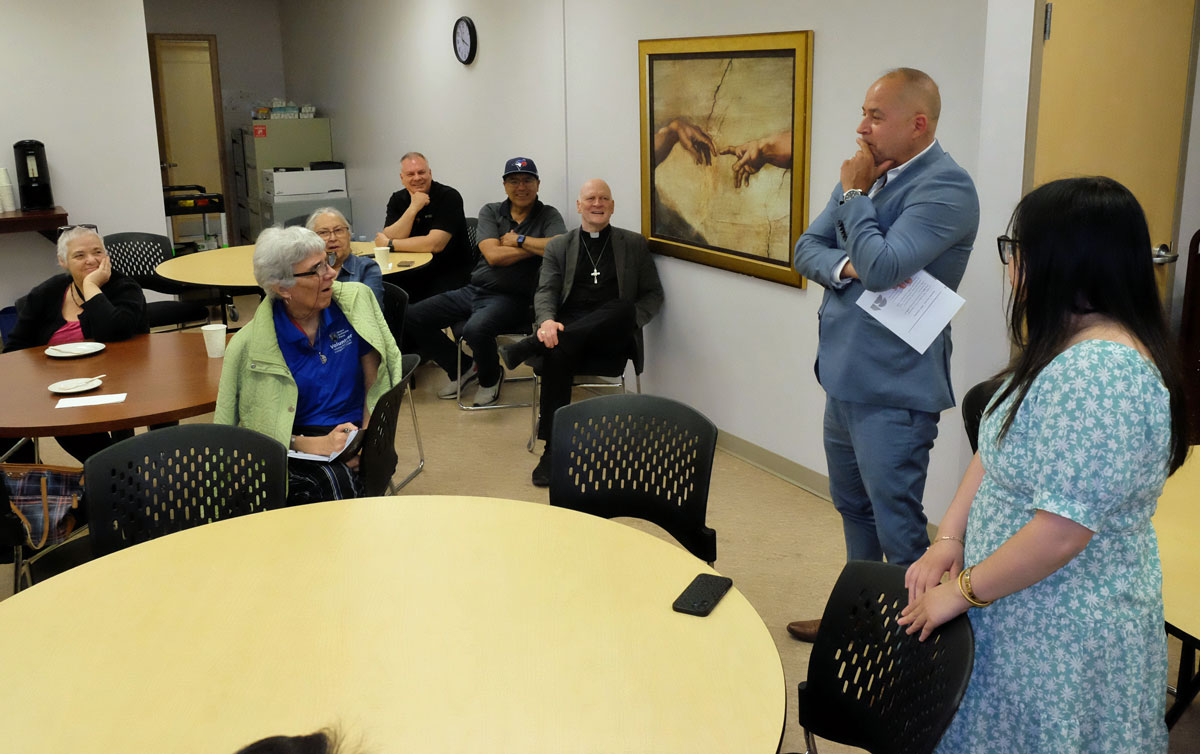
Gary Beaudin, United Way Director of Community Impact, accompanied by summer student staff member Katherine Garzona, described the summer literacy project supported by an IRF grant. (Photo by Kiply Lukan Yaworski, Catholic Saskatoon News)
Summer students like Garzona are hired to bring cultural performers, Knowledge Keepers, community members who read to the children, dancers and other cultural activities into the program, he said. “The kids really associate the positiveness around literacy and an interest in literacy with experiencing their culture and seeing reflections of themselves. That is really important.”
He noted: “Just in terms of income, many of those kids do not have the opportunity to go on the powwow trail or to go home to their home communities and experience culture there. The only opportunity that they have in the summer to experience that is when we bring performers or other things to the school.”
Sports and mentorship for youth
Kathy Hauser of Big Brothers and Big Sisters Saskatoon described an Indigenous-led Nîkânîwin Leadership Program supported by the diocesan IRF.
“It’s my pleasure today to bring thanks from Nîkânîwin program and partnership between Big Brothers and Big Sisters and Indigenous Sports Saskatchewan,” Hauser said in a report to the gathering May 22.
“Together, the partners have integrated their strengths. Big Brothers and Big Sisters bringing its proven mentorship while Indigenous Sports Saskatchewan has contributed its deep connection to Indigenous culture, communities, and sports-based programming.”

Kathy Hauser of Big Brothers and Sisters described the Indigenous-led Nîkânîwin Leadership Program for youth that is supported by a diocesan IRF grant. (Photo by Kiply Lukan Yaworski, Catholic Saskatoon News)
The leadership program is grounded in culturally-based practices designed to support holistic development of Indigenous youth, she said. “Nîkânîwin is a Cree word that means leadership or progression, which reflects the focus on supporting the youth development. The name was given to us by a Knowledge Keeper in ceremony.”
Nîkânîwin offers twice-a-week group mentoring for 10 weeks, with up to 12 youth each session led by two Indigenous mentors. Youth participate in sports, learn about culture, are introduced to Indigenous language, and develop relationships, Hauser said.
“In the last year, the funding provided allowed us to run seven Nîkânîwin groups with 76 youth participating,” she said. An outcome-based evaluation of the program reported that participating youth described feeling supported through the experience. “Our Indigenous mentors also described personal impacts, including increased confidence, improved facilitation skills, and growth in their ability to support youth,” Hauser said.
The biggest challenge for the program is getting mentors, she said, noting that honorariums for mentors has helped to encourage student leaders to step forward to help mentor youth.
Building bridges between cultures
Nicole Sindani of The People Bridge Advocacy described that organization’s Walking Together, Truth and Reconciliation Project, which continues to bring people together in a meaningful way, with a main event held Sept. 27 in Saskatoon.
The event brings out representatives of many different ethnic communities to meet Elders and residential school survivors, and hear their stories, she said. “A key impact has been active involvement of the survivors and Elders from the Saskatoon Survivor Circle. Their stories, teachings, and leadership are really central,” Sindani said.

Nicole Sindani of The People Bridge Adocacy in Saskatoon, described programs highlighting Indigenous culture and history offered with support from a diocesan IRF grant. (Photo by Kiply Lukan Yaworski, Catholic Saskatoon News)
“Through sharing circles, workshops, cultural activities, it helps the participants learn directly about residential schools, Indigenous history, and reconciliation in a real and personal way… we also continue to build ongoing relationships with Elders so they can support ceremonies, teachings, and community events beyond this program.”
IRF grants also support “Cultural Cafes” at The People Bridge Advocacy, including one upcoming on June 23, during National Indigenous History Month.
The Cultural Café includes Indigenous performers, moderators, and Elders, with drumming and Indigenous and/or Métis traditions highlighted.
“In reality these projects or connection could not have been done without the support and funding from the Indigenous Reconciliation Fund in the Roman Catholic Diocese of Saskatoon. So we’re beyond grateful for the opportunity to make this happen,” Sindani concluded.
A continuing journey
The IRF partnership gathering May 22 at the Catholic Pastoral Centre in Saskatoon opened with a prayer and introduction by Lyndon Linklater, a member of the diocese of Saskatoon’s IRF Discernment Circle and a traditional Knowledge Keeper of Thunderchild First Nation, with roots in Couchiching First Nation in Ontario.
Relating his family history, which included his father attending Catholic residential schools in Ontario and in LeBret, SK, for 12 years, before going on to study at Moose Jaw Teacher’s College. His mother attended a Catholic residential school for five years, from the age of 9 to 14 years, before running away.
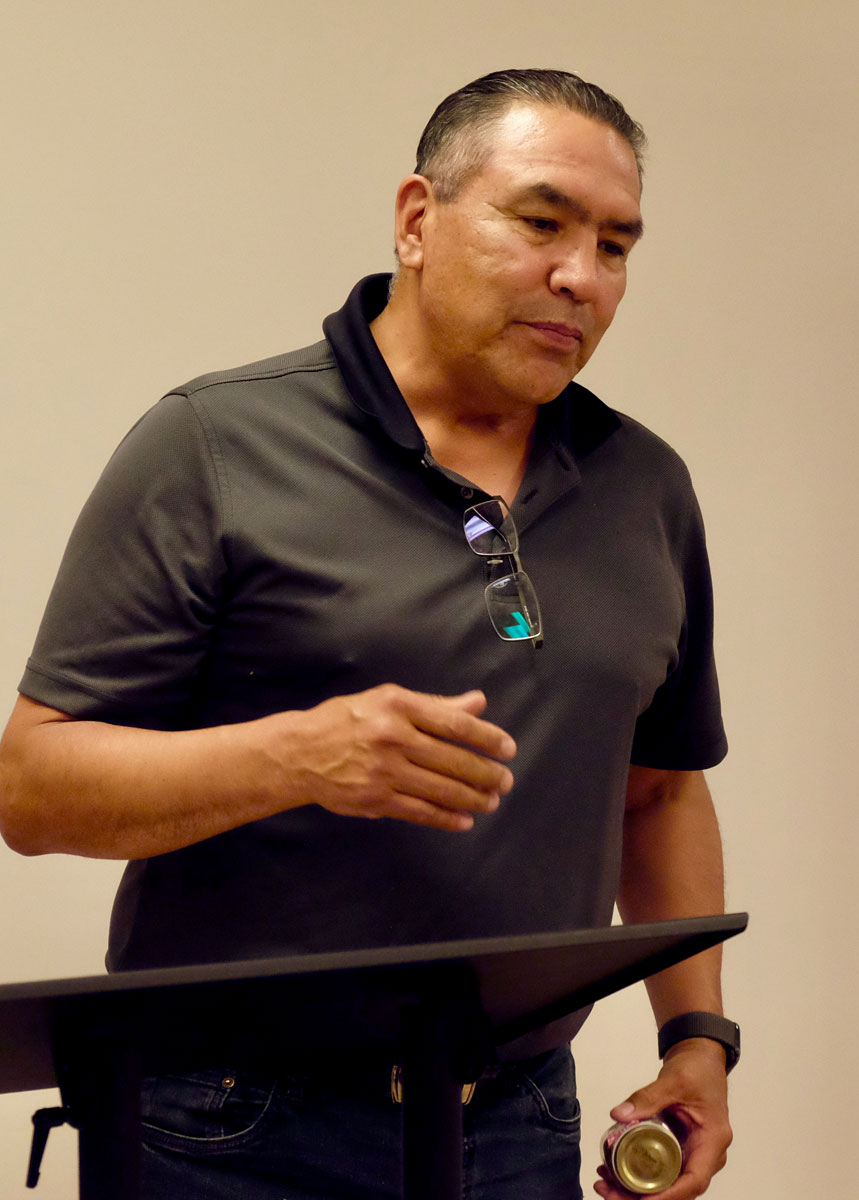
Lyndon Linklater of the diocesan IRF Discernment Circle, offered an opening prayer and reflection at the annual gathering May 22 in Saskatoon. (Photo by Kiply Lukan Yaworski, Catholic Saskatoon News)
“There was a time where I had a lot of anger with the church, the Catholic church, I had a lot of anger and resentment. But in order for me to heal, to, you know, live a good life, I had to learn to forgive,” Linklater said. “And so in my journey, about 10 years ago or so, I started doing work with Catholic school divisions, because the Catholic Church made a decision to go on this journey called truth and reconciliation.”
In addition to Pope Francis’ apology, the Canadian bishops have been leading Catholics on a journey towards truth and reconciliation, Linklater added. “It’s such a beautiful thing, you know, to see our leaders supporting this journey.”
Thanking the bishop of Saskatoon and all those present for their involvement in truth and reconciliation, Linklater also encouraged everyone to continue the journey: “It’s not going to finish tomorrow. It’s not going to finish next month. It’s not going to finish next year. It’s going to take time. It’s going to take generations. but this is what we have to do. And in the end, oh, we’ll be so much all better off for it.”

The annual IRF partnership gathering May 22 was attended by parishioners and representatives of groups offering programs with support from the IRF. (Photo by Kiply Lukan Yaworski, Catholic Saskatoon News)
During the gathering, Bishop Mark Hagemoen also spoke about the ongoing journey of truth and reconciliation, and the role of the IRF.
“I’m grateful to my brother bishops for their energy and their desire to build on the apology of Pope Francis to do something practical,” Hagemoen said of the establishment of the IRF. “It’s not perfect, it’s not everything, but it’s something in terms of Indigenous reconciliation.”

Bishop Mark Hagemoen thanked all the organizations and partnership groups that are providing programs supported by the diocesan IRF. (Photo by Kiply Lukan Yaworski, Catholic Saskatoon News)
“We look to God the Creator and Father, and we look to Jesus for the ways in which God cares for his people. He loves his people and he’s been constantly calling them to his heart from the time of the beginning of creation and we see the great lengths that God always goes when people are hurt, when they’re fallen, when they’re dealing with tremendous injustice and all sorts of things that happen in our fallen world,” said the bishop.
“Our lives are wrapped up with each other and the moment that we pull ourselves away from each other in groups or even individually to a place where we don’t care, there are repercussions. It’s not healthy, it’s not good.” The IRF is one way to serve and care for each other, he said.
“I am really grateful for the range of projects that have happened,” Hagemoen added. “You know this is a small local context and yet there’s all sorts of good things that are happening because of this opportunity to share a few resources.”
The bishop concluded with words of thanksgiving and blessing for those who are helping to steward the projects assisted by the IRF.
“We’re in this together – and as Lyndon said, reconciliation is a long journey, there’s a lot of work to do, but it’s good to be making some progress as we’ll be on this journey for a long time.”
IRF background
Raissa Bugyi, Executive Director of the Diocese of Saskatoon Catholic Foundation, also spoke, extending thanks to donors and parish communities for supporting fundraising for the IRF and “for going the extra mile to learn why this work matters so deeply.”

Raissa Bugyi of the Diocese of Saskatoon Catholic Foundation thanked donors and parishes for their support of the IRF. (Photo by Kiply Lukan Yaworski, Catholic Saskatoon News)
“Your willingness to listen, to engage and to stand with those who need compassion and justice is a true witness of our faith in action,” Bugyi said. “We know this is not always an easy path and at times supporting this work can bring questions, criticism and resistance, yet courage has always been part of discipleship. As followers of Jesus we are called not only to believe, but to act with love, mercy and integrity especially when it is difficult.”
Myron Rogal, coordinator of Justice and Peace for the Roman Catholic Diocese of Saskatoon who works with the diocesan IRF Discernment Circle, spoke on behalf of co-chairs Gordon Martell and Kelley Cardinal, who were unable to be present. Rogal provided an overview of the IRF, and the next funding “window,” July 1 to Sept. 30, for submitting grant applications (LINK to more information).

Myron Rogal, diocesan coordinator of Justice and Peace, and a member of the IRF Discernment Circle, provided an overview of the fund. (Photo by Kiply Lukan Yaworski, Catholic Saskatoon News)
Rogal noted that the diocese is entering the fifth year of the five-year IRF commitment. “There is some energy and some discussion about continuing past that time: it will look different if it is to continue.” In the meantime, fund-raising and grants in support of local projects and initiatives continue, he said.
All grants are made in consultation with Indigenous representatives, to Indigenous-led projects that prioritize:
- Healing and reconciliation of communities and families.
- Culture and language revitalization, education and community building.
- Dialogues involving Indigenous Elders, spiritual leaders and youth focusing on Indigenous spirituality and culture.
Grants are awarded to registered charities, with the granting committee looking at projects from the dual ethical lenses of Catholic social teaching, and “miyo-wîcêhtowin” a Cree world-view emphasizing good relations among people, sacred laws and the Creator.
The diocesan Indigenous Discernment Circle and its granting committee include Elders, Survivors, and children of survivors, Rogal noted. “There are 13 First Nations, two Métis, and two ex officio non-Indigenous members of these committees.”
Inclusion of Indigenous peoples in all aspects of the IRF initiative has been a priority, Rogal said, stressing that funding decisions are considered through Indigenous paradigms, with an emphasis on collaboration with the wider community. He added that accountability and transparency are also priorities for the IRF both for funded projects and in its own operation.
The annual gathering May 22 is one of the diocesan Discernment Circle annual events rooted in its covenant statement. It included a time for networking and sharing of refreshments.
Discernment Circle IRF grants awarded so far through the diocese of Saskatoon IRF:
For more information about the diocese’s Indigenous Reconciliation Fund, including application forms for projects, reports about disbursements during the first three years, and links to donate to the fund, see the website: rcdos.ca/indigenous-reconciliation-fund.
-30-
Kiply Lukan Yaworski is the communications coordinator for the Roman Catholic Diocese of Saskatoon: rcdos.ca. Communications and Catholic Saskatoon News are supported by gifts to the Bishop’s Annual Appeal: dscf.ca/baa.