
By Terry O’Neill, The B.C. Catholic
This article is part of a B.C. Catholic “MAiD at 10” series examining the scale and impact of medically-provided death in Canada, 10 years after its legalization.
[Vancouver – Canadian Catholic News] – As the Canadian Senate considered expanding medically-provided death eligibility in 2021, a group of 15 prominent Indigenous leaders complained they had not been properly consulted on the matter and, moreover, that they had “grave concerns” about legalized euthanasia’s adverse impact “on our vulnerable population.”
Parliament pressed ahead with the expansion of what is known as “MAiD” despite the Indigenous concerns. The federal government then launched a program that focused more on better data collection and “listening” to diverse viewpoints than on protecting vulnerable Indigenous people from medically-provided death.
For at least one prominent MAiD critic, the federal government appeared more concerned with actively increasing Indigenous peoples’ access to medically-provided euthanasia than with improving the delivery of health services to them. health service delivery for them.
“It’s a sort of reverse discrimination,” Alex Schadenberg, executive director of the Euthanasia Prevention Coalition, said in an interview. “It’s horrible, because the Native community was saying, ‘We don’t want this.’”
Indigenous peoples were very clear that euthanasia does not fit with their cultural values, Schadenberg said. “And how does Health Canada respond? By focusing on ways to make it easier for Indigenous people to access MAiD.”
He said the evidence is in Health Canada’s Sixth Annual Report on MAiD, released last November with statistics from 2024. of last year, which focuses on 2024 statistics.
.
The report noted that Caucasians, who make up about 70 per cent of Canada’s population, accounted for 96 per cent of those receiving medically-provided death in 2024. Indigenous people, by contrast, represent about five percent of the population but only 0.4 percent of euthanasia recipients.
“You’d think Health Canada might at least wonder why so many Caucasians were opting for MAiD, but it doesn’t, said Schadenberg. “But there’s a whole section on the Indigenous numbers, and it seems more concerned about improving data collection and addressing inadequate access to MAiD than about protecting Indigenous life.”
The section entitled “Indigenous people who received MAiD” reports that low euthanasia numbers among Indigenous persons may be due to challenges in accessing the medically-provided-death service, as well as “distrust of the health care system, based on experiences of anti-Indigenous racism,” potential “discomfort and/or lack of understanding” regarding euthanasia, and “potential disconnection between MAiD and Indigenous worldviews.”
Given that three of the four factors suggest Indigenous opposition to medically-provided death, Schadenberg wonders why more isn’t being done to protect them from euthanasia.
It’s a concern shared by Brendon Moore, national chief of Canada’s Congress of Aboriginal Peoples. As reported in August 2025 in Canada’s National Observer, Moore said MAiD’s availability, especially related to the looming March 2027 expansion of medically-provided death to those whose sole underlying condition is a mental illness, is especially troubling for communities that already experience high rates of suicide as a result of the effects of inter-generational trauma and systemic racism.
“We’re looking for an equitable opportunity to live first,” he said. “If we had culturally safe palliative care and mental health support, some people might choose that path instead of moving toward MAiD.”
Reporter Sonal Gupta summed up the problem by writing, “The nightmare scenario: MAiD could substitute investments in living supports and mental health care if underlying conditions aren’t addressed first.”
Moore did not respond to a request from the B.C. Catholic to comment further on the issue.
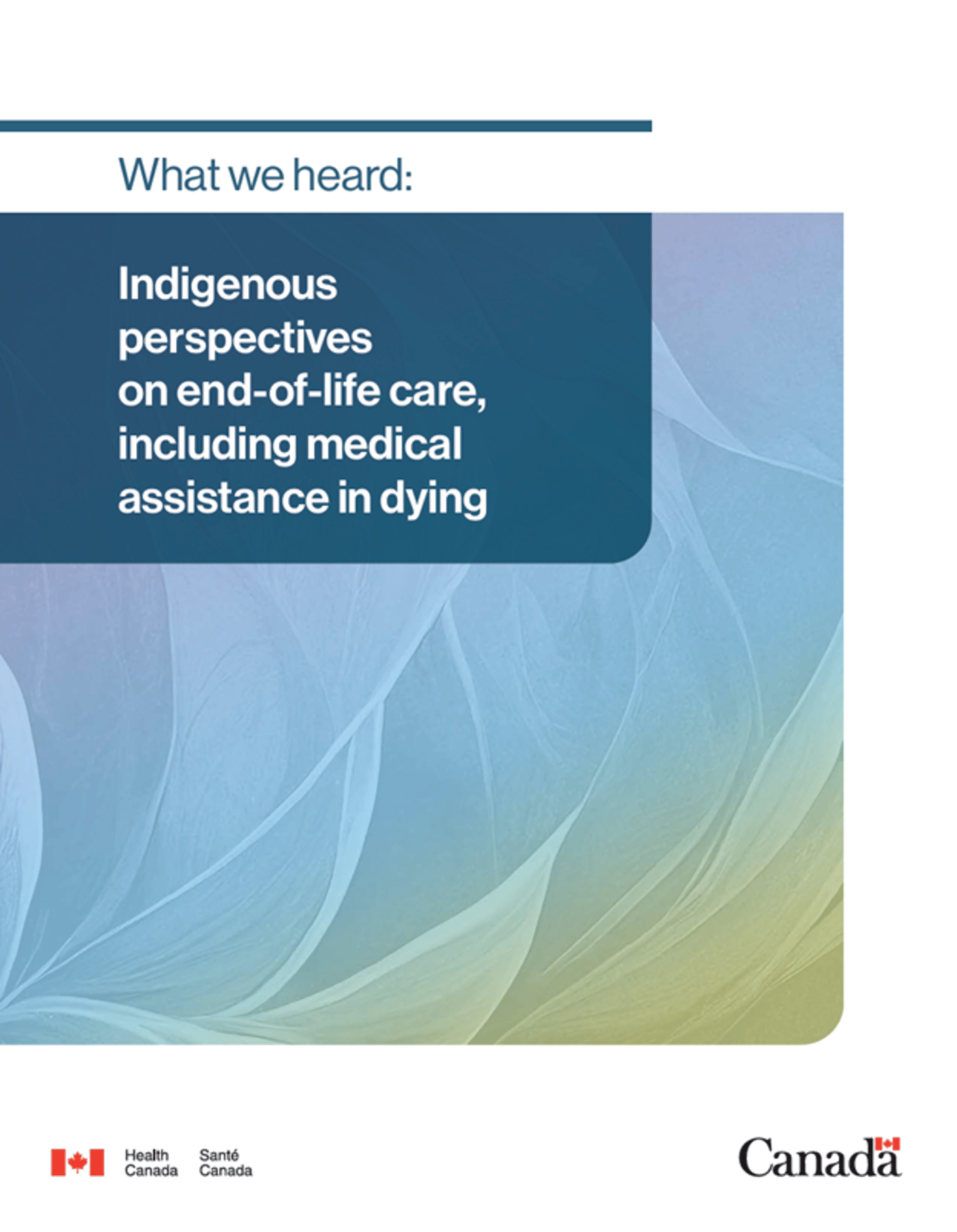
Gupta also reported that, according to a document obtained through an access-to-information request, the federal government invested more than $3.3 million in Indigenous-led MAiD consultations across the country. In fact, just weeks after Health Canada published its latest euthanasia statistical report, it published a report on the results of those consultations.
The December 2025 report says Indigenous opinion on medically-provided death is generally divided into three camps: support without qualification, openness only in certain circumstances, and opposition. The report does not provide percentages for each group.
Among those opposed, some participants feared that medically-provided death might normalize or even encourage suicide, while others said there is an urgent need for accessible, culturally appropriate health care, mental health care, and life-promotion initiatives.
The report’s summary on Indigenous opposition points to strong moral, spiritual, and religious values as the foundation of that opposition. “They said that an end-of-life decision should not be made by humans and to control it through MAiD was to overstep human boundaries,” the report states. “Death should be left in the hands of a Creator, God or higher power.”
Some opponents also view medically-provided death as a continuation of colonial policies or a means to control and harm Indigenous peoples. “For them, MAiD is the same as murder, genocide or a sin and the systematic euthanasia of vulnerable people,” the report states. “Some participants felt that an individual could be coerced into choosing MAiD, with one participant saying that Indigenous peoples may be ‘bullied into a decision.’”
-30-
Canadian Catholic News (CCN) is a national news service, with members including Catholic newspapers, organizations, and individuals: CanadianCatholicNews.ca
Communications and Catholic Saskatoon News is supported by gifts to the Bishop’s Annual Appeal: dscf.ca/baa.