By Nicholas Elbers, The B.C. Catholic
[Vancouver- Canadian Catholic News] – Vancouver St. Paul’s Hospital staff contemplating next year’s opening of a state-of-the art facility in Vancouver’s False Creek Flats recently had an opportunity to reflect on the Catholic vision and mission behind St. Paul’s and Providence Health Care.
Hospital personnel gathered in the Cullen Lecture Theatre Feb. 4 for National Catholic Health Care Week to hear administrators and clinicians share their thoughts on what makes Catholic health care distinctive across Providence Health Care.
“Our mission doesn’t live in bricks and mortar,” said Dr. Dan Kalla, a Providence emergency physician and senior medical director. “We bring the mission with us.”
The lunchtime discussion History of Living the Values [at Providence Health Care] was hosted by two Providence care teams — Mission Integration and Culture in collaboration with Spiritual Health and Pastoral Care.
On the panel with Kalla were Dr. Janet Kow, vice-president of quality and safety and long-term care; Tyler Paetkau, a clinical ethicist and PhD student at UBC; and Danielle Richards, a nurse and director of quality, education and practice excellence in elder care.

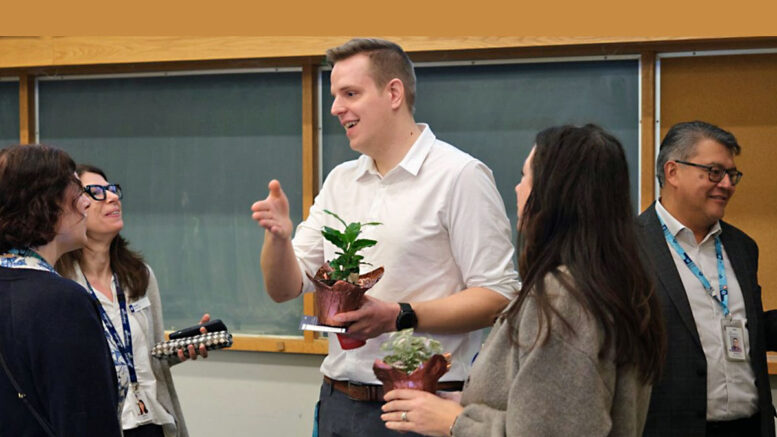
Providence Health Care director of mission engagement and emcee Adrienne Castellon, Dr. Dan Kalla, Dr. Janet Kow, Francis Maza, Danielle Richards, and Tyler Paetkau at the recent Vancouver gathering. (Photo by Nicholas Elbers, The B.C. Catholic, CCN)
Kalla described how the Providence mission extends beyond the complexity of the medicine practised within hospital walls, and is older than its long history in Vancouver. It continues from the religious sisters who first brought health care to British Columbia and it remains embedded in the organization as a whole.
Those values, Kalla said, shape how care is delivered, how staff treat one another, and how decisions are made, especially when choices are difficult.
In his opening remarks, Francis Maza, vice-president of mission, ethics and spirituality, grounded the conversation in the history of faith-based health care in Canada. He reminded the audience that Catholic health care has been part of the country’s social fabric for more than four centuries..

Providence Health Care’s vice‑president of mission, ethics and spirituality Francis Maza speaks at the Vancouver event. (Photo by Nicholas Elbers, The B.C. Catholic, CCN)
“Before Canada was a nation, Catholic sisters were travelling across this country serving people,” Maza said. “They didn’t choose the easiest places. They chose the places where people were sick, poor, abandoned, or forgotten.”
That legacy, he said, is not confined to the past, and Catholic Health Care Week “isn’t just about celebrating who we are,” Maza said. “It’s about asking how we live these values in real situations—when resources are tight, when people are anxious, and when there isn’t a clear answer.”
As an ethicist, Paetkau said Catholic social teaching provides a crucial lens for answering those questions. He cautioned against viewing Catholic health care as a constrained version of secular care, defined mainly by what it does not provide.
“People can have this idea of Catholic health care as ‘health care minus,’” he said, as though it’s “secular health care, but there’s certain things that we don’t do.”
While there are practices that aren’t done in Catholic hospitals, Paetkau pointed out that no health-care facility provides every health service. There are also “ways that the Catholic identity shapes what we do and causes us to go further in a lot of situations.”
He spoke about the myriad ways Catholic social teaching informs the “extra mile” approach often taken by Catholic health workers.
It’s a teaching that doesn’t settle for excellence but pushes beyond to the marginalized and forgotten, with the Church’s preferential option for the poor actively expanding the scope of care. “It’s about identifying who is most vulnerable and choosing to stand with them,” Paekau said.

Adrienne Castellon, left, listens as Dr. Janet Kow responds to a question at the Vancouver event. (Photo by Nicholas Elbers, The B.C. Catholic, CCN)
Such choices have concrete consequences for where and how Providence operates, Paetkau said. Serving people without stable housing, patients living with addiction, and those with medical needs deeply intertwined with trauma creates ethical complexity, but it’s hardly a flaw in the system.
In the same way, the decision to build the new hospital near the Downtown Eastside is “not a bug,” he said. “We’ve deliberately chosen to go into those places.”
Many of the ethical consultations Paetkau becomes involved in involve difficult discharges of patients who don’t have a safe home to return to. Rarely simple and often emotionally charged, such decisions reflect the very populations Catholic health care has historically prioritized.

Health-care professionals in the Cullen Lecture Theatre at St. Paul’s Hospital in Vancouver, B.C., for a discussion on Catholic health care’s vision. (Photo by Nicholas Elbers, The B.C. Catholic, CCN)
“It’s why the new St. Paul’s Hospital (in Vancouver) is going to be closer to the downtown eastside than the current one,” he said. “It’s why we have things like May’s Place Hospice and Central City Lodge” providing long-term care.
Providence’s Catholic identity “has prompted us to go into those areas,” and Paetkau said he feels privileged to work for an organization that has made that choice.
Kalla echoed Paetkau from an emergency medicine perspective, where decisions often have to be made under intense pressure and without clear consensus. The principle of human dignity provides a defensible moral starting point even when outcomes are imperfect, he said.
“There are situations where there is no easy or necessarily right answer,” he said. But when a decision is based on “the most dignified approach, everybody understands the principle behind it.”
That principle of dignity surfaced in stories shared by Kow, who described Providence’s work in long-term care and with Indigenous patients.
In one case, a First Nations woman with cognitive impairment and suffering residential school trauma faced frightening prospects for long-term care. Rather than forcing her discharge, the care team slowed the process, explained each step, and worked with her until trust was built.
“In any other place I’ve worked, it would have been, ‘Too bad, she needs long-term care,’” Kow said. “Here, the team said, ‘We’re going to let her stay, we’re going to work through it.’”
As the conversation turned to the future and the move to the new hospital building in Vancouver, the panellists reflected on how the Catholic hospital’s identity can be carried forward. Kalla said one way is to remember it intentionally amid the move into an advanced $2- billion facility.
“Once we’re in a new, shiny place, it’s easy for attitudes to shift,” Kalla said. “We can’t forget where we came from.”
Kow echoed his concern, noting Providence’s long history of working in complexity and constraint. “We’ve always been the ones doing the hard work in tough places,” she said. “We have to keep walking that story.”
-30-