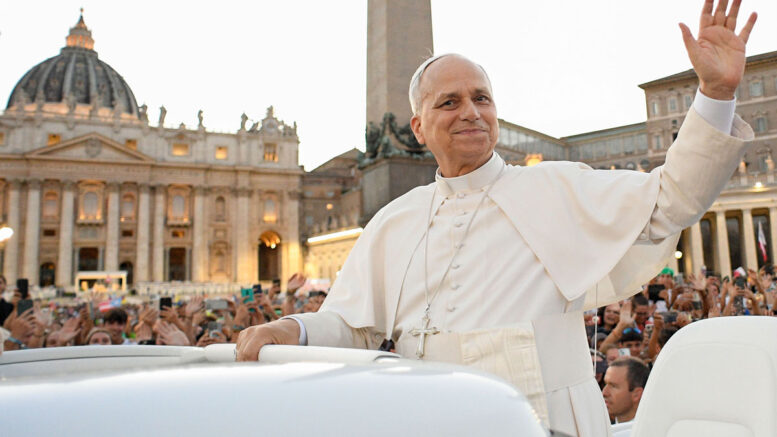
By Mickey Conlon, The Catholic Register
[Canadian Catholic News] – When Pope Francis opened the Holy Door in St. Peter’s Basilica to officially launch Jubilee Year 2025, little did anyone know that when it would close just over a year later, it would be at the hands of his successor to the See of Peter.
Not since 1700, with the death of Pope Innocent XII and election of Pope Clement XI as his successor, would two popes preside over a Jubilee Year. Pope Leo XIV was handed the torch from Pope Francis, who died April 21, just one day after delivering what would be his final Easter Sunday “urbi et orbi” blessing.
And though Francis’ ill health over the last few years of his papacy was well documented, witnessed firsthand by Canadians who welcomed a wheelchair-bound Francis during his 2022 Pilgrimage of Penance to our nation, his death still came as a shock to the world.
Perhaps no one was more shocked was Cardinal Robert Prevost, the American-born prelate who would be elevated to the papacy May 8 just days after his predecessor’s death. The new pontiff took the name Leo XIV and immediately was thrust into a new world, which included being called upon to fulfill the commitments of Francis for this Jubilee Year.

Pope Leo XIV, the former Cardinal Robert F. Prevost, prays as he stands on the central balcony of St. Peter’s Basilica at the Vatican after his election as pope May 8, 2025. The new pope was born in Chicago. (Photo by Lola Gomez, CNS)
The solemn celebrations that surround a Jubilee Year come happen once every 25 years. Special Jubilee celebrations were planned for most weekends, and not even the death of a pope could bring these celebrations to a stop.
Enter Pope Leo, who inherited a full calendar: one he would shape into his own. As Archbishop Rino Fischella, organizer of the Jubilee 2025 events and pro-prefect of the Dicastery of Evangelization, would say, “Pope Leo XIV accepted the calendar without fear and, from the beginning, chose to maintain the programmed Jubilee commitments.”
And what else would the world’s 1.4 billion Catholics expect? Perhaps Fischella put it best when he said the fact Pope Francis would not finish what he had begun is of “profound symbolic value.”
“Let this unfinished gesture become an invitation for every believer: The mission of the Church never closes,” he said.
The mission of the church never does close — for 365 days each year, 24 hours a day, the heart of the Church is open, not just to said 1.4 billion Catholics, but to all of God’s children. And Pope Leo has shown this each day since assuming the papacy. To many observers, it’s been a fairly seamless transition, beyond just seeing the Jubilee year through to its end. Many might argue the Church under Leo XIV is a mere continuation of the Francis papacy.
On synodality, one of Francis’ great achievements as he steered the Church on its journey together in understanding her mission and looking to the future, Leo has been a champion. Yet he has also shifted the conversation surrounding it, with signals of a more unifying approach toward more traditionally-minded adherents to the pre-conciliar liturgy.
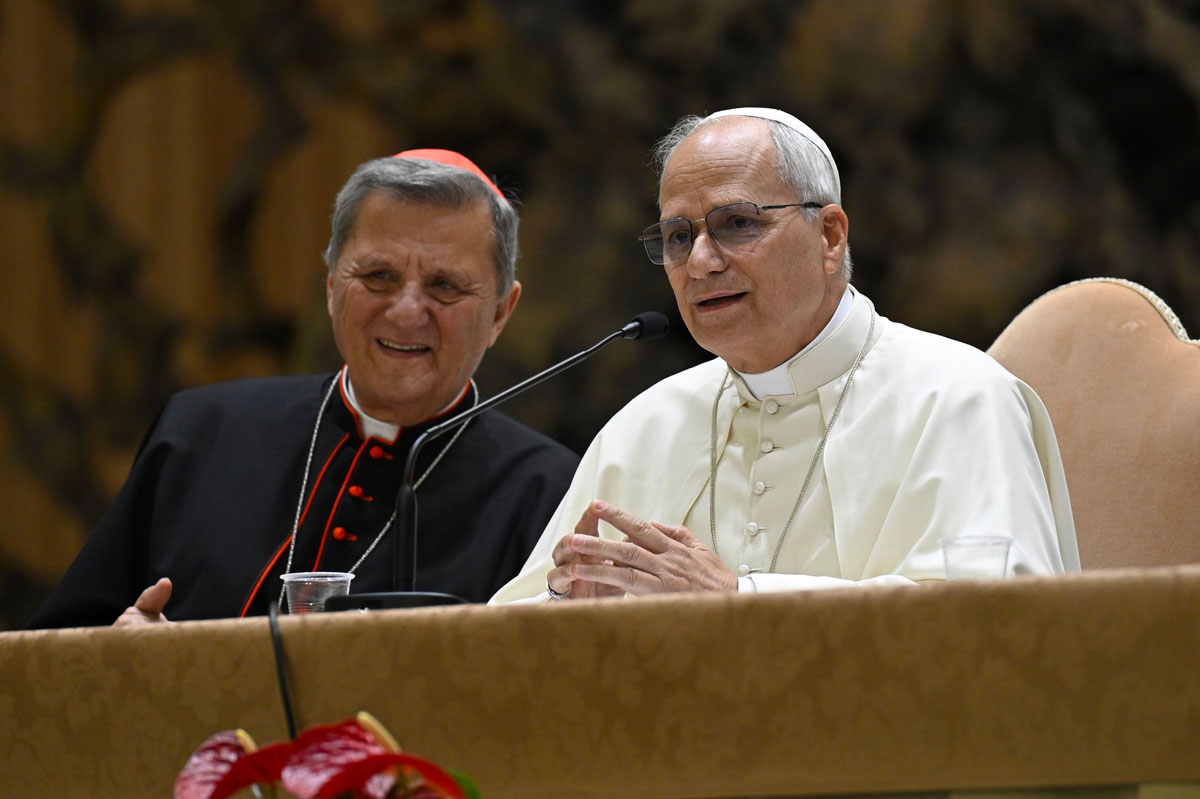
Pope Leo XIV, with Cardinal Mario Grech, secretary-general of the Synod of Bishops, listens to and answers questions from participants in the Jubilee of Synodal Teams and Participatory Bodies in the Vatican audience hall Oct. 24, 2025. (CNS photo/Vatican Media)
Concern for the poor
Pope Leo’s first apostolic exhortation, released in early October, may make one see this continuity as well. Dilexi Te (I Have Loved You) on the Church’s love for the poor could be words taken directly from Pope Francis’ mouth. In fact, it was begun by Pope Francis and was unfinished at the time of Francis’ death. Pope Leo would then complete his predecessor’swork. Canadian Cardinal Michael Czerny, when asked what percentage Pope Leo added to the original, responded: “It is 100 per cent Francis, and it is 100 per cent Leo.”
While that math may not add up, it was clear that the two pontiffs see the Church’s love for the poor in the same light.
Pope Leo writes: “Love for the poor — whatever form their poverty may take — is the evangelical hallmark of a Church faithful to the heart of God. I am convinced that the preferential choice for the poor is a source of extraordinary renewal both for the Church and for society, if we can only set ourselves free or our self-centredness and open our ear to their cry.”
In reality, many of the other 266 popes have shone this same light on the poor. Could you listen to the words of the sainted Pope John Paul II and not hear that same call? Or Pope Paul VI? Benedict XIV? Leo I through XIII?
Ability to connect
And like so many of his predecessors, Pope Leo XIV has demonstrated his ability to connect to people.
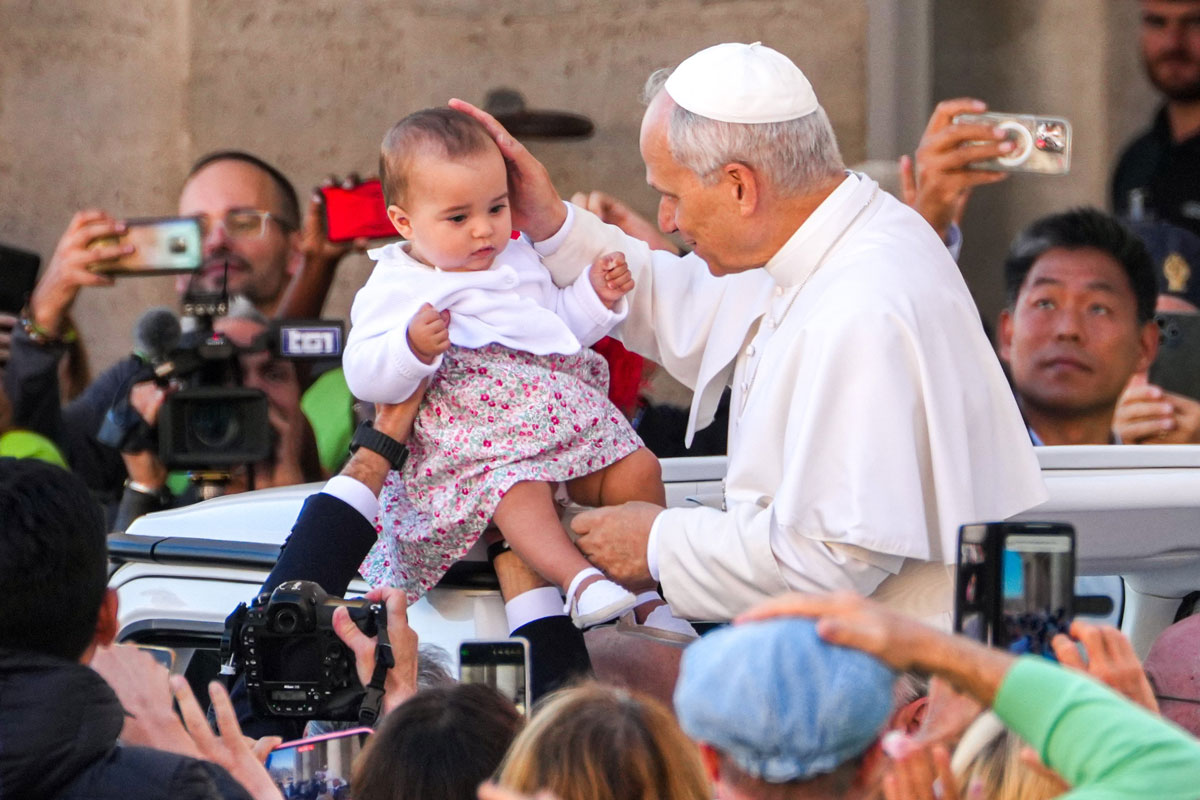
Pope Leo XIV greets greets a child as he rides around St. Peter’s Square following Mass for the Jubilee of Catechists at the Vatican Sept. 28, 2025. (Photo by Lola Gomez, CNS)
In early August, just three months into his papacy, the Jubilee of Youth drew about one million young people to Rome. The Holy Father’s message to the gathered youth — continuing the path of his predecessors — would be familiar to the hundreds of thousands who gathered in Toronto 23 years earlier for World Youth Day.
Just as John Paul II told those gathered under the steamy mid-summer Toronto celebration in 2002, Leo told those in Rome this summer, “You will be the salt of the earth, light of the world.” Pope Leo continued: “You will be seeds of hope wherever you live: in your families, with your friends, at school, at work, in sports. Seeds of hope with Christ, our hope.”
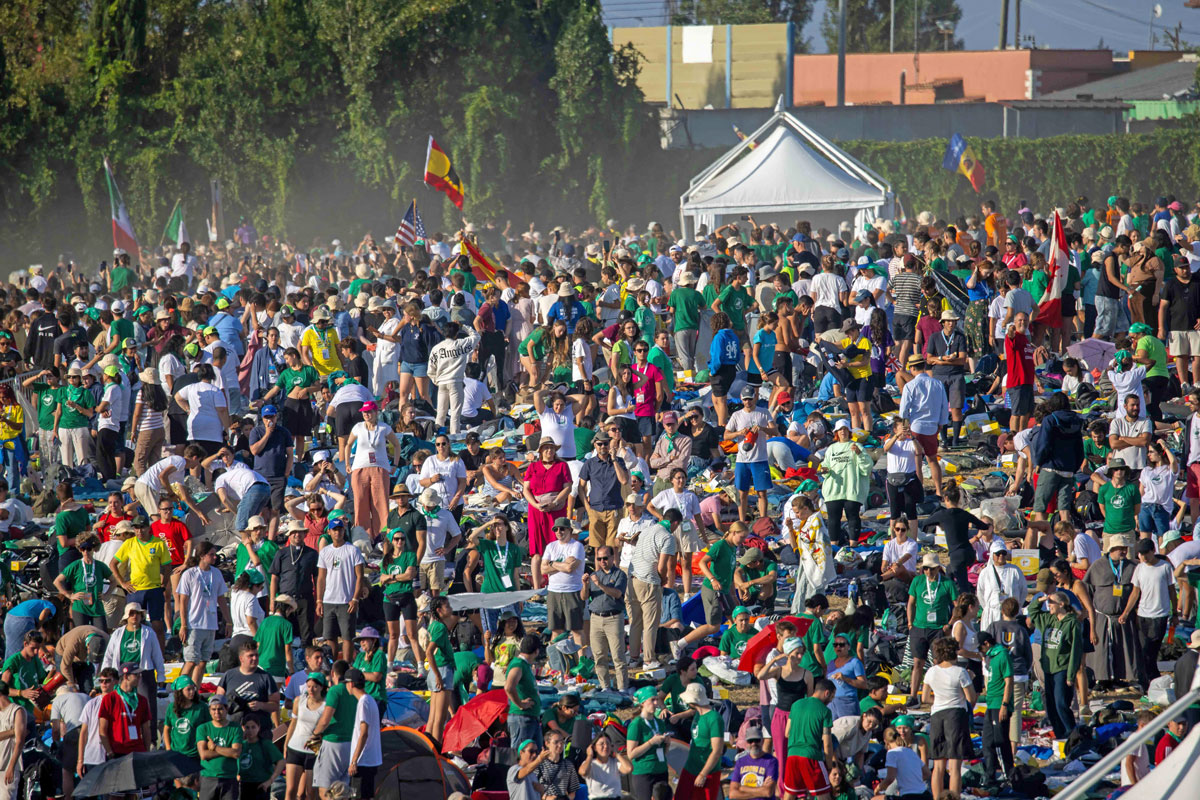
Pilgrims gather for Mass closing the Jubilee of Youth in Rome’s Tor Vergata neighborhood Aug. 3, 2025. (Photo by Pablo Esparza, CNS)
This ability to connect was also evident on the world stage, when in late November 2025, Pope Leo embarked on his first foreign trip to Turkey and Lebanon.
During the trip planned around an ecumenical celebration of the 1,700th anniversary of the Council of Nicaea and the Nicene Creed that most Christians abide by, Pope Leo offered his encouragement to the minority Catholic communities in these lands, while demonstrating the utmost respect for the majority Muslim communities.
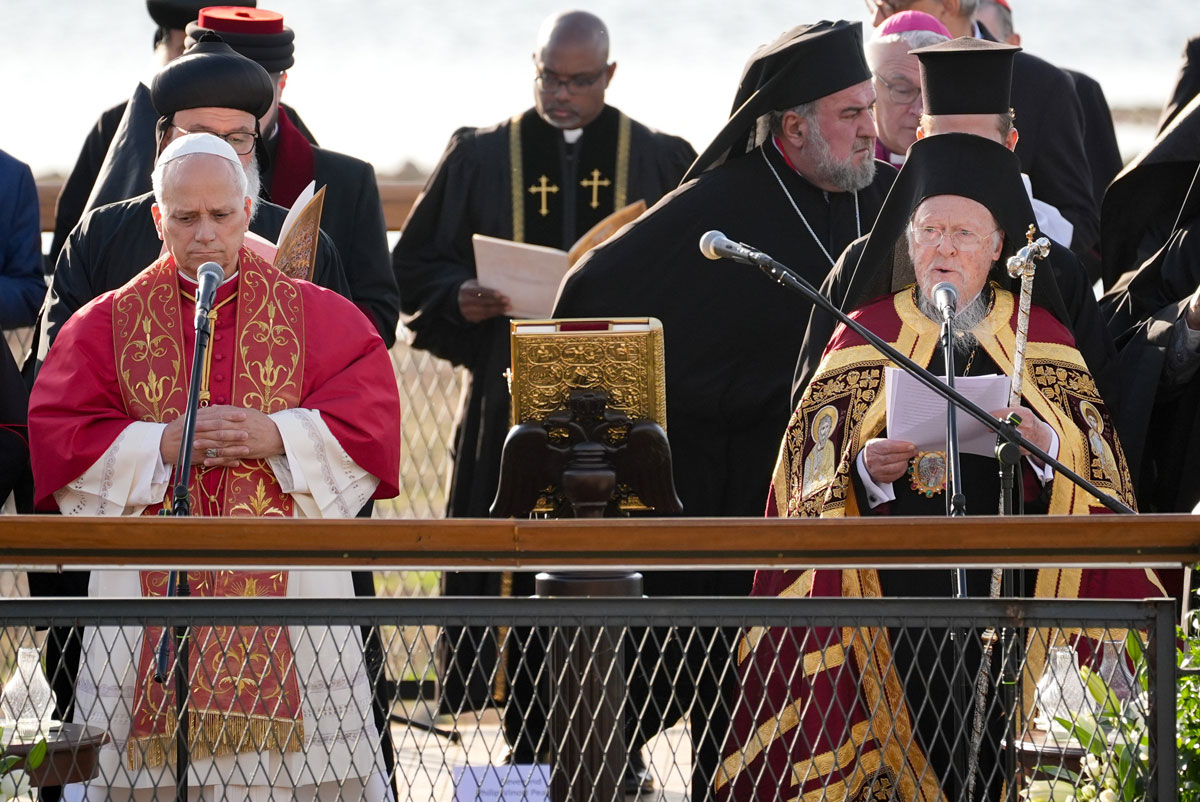
Pope Leo XIV joins Orthodox Ecumenical Patriarch Bartholomew and other Christian leaders for an ecumenical prayer service in Iznik, Turkey, Nov. 28, 2025. The gathering marked the 1,700th anniversary of the Council of Nicaea, convened in 325 A.D., which produced the Nicene Creed and defined foundational Christian doctrine. (Photo by Lola Gomez, CNS)
“The more we can promote authentic unity and understanding, respect and human relationships of friendship and dialogue in the world, the greater possibility there is that we will put aside the arms of war, that we will leave aside the distrust, the hatred, the animosity that has so often been built up and that we will find ways to come together and be able to promote authentic peace and justice throughout the world,” he told reporters on the flight back to Rome.
Legacy of Pope Francis
While Catholics look forward to what Pope Leo can bring to the Church and the world, we can’t forget Pope Francis and what his 12 year papacy meant. An outsider when elevated to the papacy in March 2013, Pope Francis will be remembered for so much, from the unprecedented scenario of living side-by-side in the Vatican with Pope Benedict XIV, to penning Laudato Si’ , his now 10-year-old encyclical on the care for our common home.
Love him or hate him — and there are plenty on each side of that ledger — there’s no doubt he left his mark. Ines San Martin, the vice president of communications at the Pontifical Mission Societies USA, writing in OSV News, said: “Perhaps the best early epitaph is this: Pope Francis was a man who electrified the world and delivered a sort of shock therapy to the Church he led, driving it to rethink established patterns and to go boldly where it hadn’t before. His record as CEO may be mixed, his positions on specific political or ecclesiastical matters debatable, but no one can say Francis didn’t have their attention.” (Amen.)

A light shines on a replica of Pope Francis’ pectoral cross above his tomb in the side aisle of Rome’s Basilica of St. Mary Major early April 27, 2025. (Photo by Lola Gomez, CNS)
Further to the Jubilee — Rome, one of the most visited cities in the world at the best of times, saw a huge influx of pilgrims this year. Estimated numbers vary, but it is safe to say the Eternal City had a record-breaking year for tourism. And the city can thank the pilgrims who came for the Jubilee, many of them Canadians, including Toronto’s Cardinal Frank Leo who was accompanied by more than 100 pilgrims from the archdiocese of Toronto.
The Jubilee Year was not a Rome-alone phenomena. Dioceses worldwide took part in this once-every-25-year celebration of the faith. In Toronto, Cardinal Leo celebrated numerous special liturgies throughout the year, including a gathering of more than 4,000 in late August at the Martyrs’ Shrine in Midland, Ont. The Church was truly a Jubilee Church in 2025.
Christian persecution
While so many celebrated the beauty and wonder of Our Lord and His Church over this past year, what can’t be forgotten are those who suffered for their faith.
So many Christians continue to be persecuted, a sad fact too often detailed in the pages of the Catholic Register over the past year and beyond. Nigeria in particular, the two Sudans, Armenia — the faithful in those nations suffered constant religious persecution.
It is reported that in Nigeria alone, 32 Christians have been killed each day, millions are displaced, parishes have closed due to the spectre of violence and rampant kidnappings are a constant threat — as seen in the 315 students and staff kidnapped from St. Mary’s School in Niger state on Nov. 22.
As Nigerian-born Fr. Gordian Okpuruka told The Catholic Register earlier this month, what is transpiring in his homeland “is horrifying and very troubling.”
Walking in hope
But as Catholics, and as we approach a new year, there is always hope. We don’t know what 2026 will bring, surely much of the same, but we remain hopeful: for a better future, for a better life for one and all, and the hope — no, not just hope, but the knowledge — that Our Lord will continue to look out for us.
-30-
Canadian Catholic News (CCN) is a national news service, with members including Catholic newspapers, organizations, and individuals: CanadianCatholicNews.ca
Communications and Catholic Saskatoon News is supported by gifts to the Bishop’s Annual Appeal: dscf.ca/baa.